
Why a Great Rental Property Can Still Make a Poor Refinance
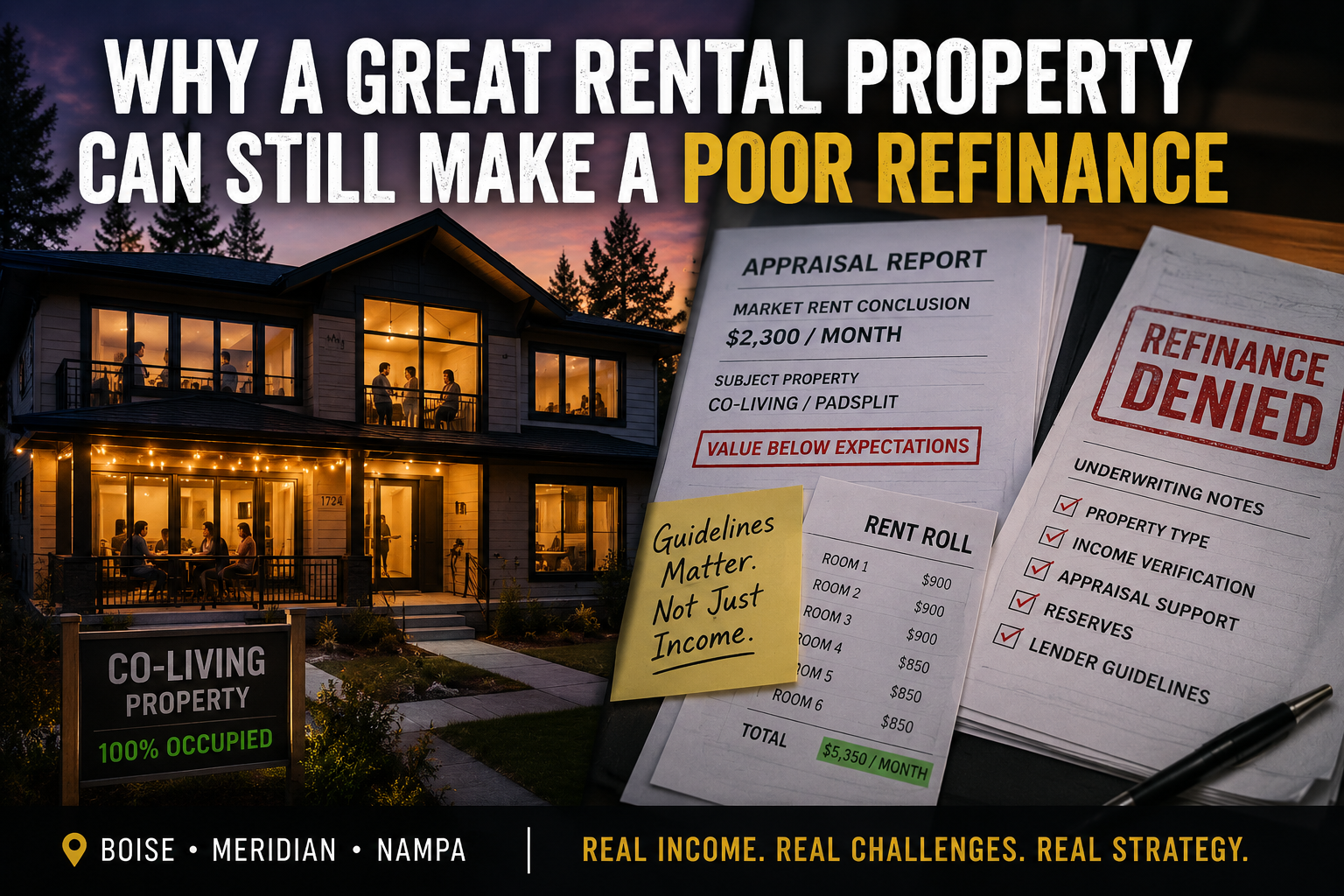
By Patrick Penner • I get this call more than almost any other. An investor has a co-living or PadSplit property in Boise, Meridian, or Nampa that is performing exactly the way they hoped. Every room is rented. The income is real. And then the refinance comes back nothing like they expected.
This isn't a story about a bad property. It's a story about a good property being evaluated by a process that was never built to see it clearly. If you're still in the acquisition phase, our co-living DSCR underwriting guide covers how lenders evaluate these properties at purchase. This article is for investors who already own the property and are trying to understand why the refinance isn't working the way they expected.
The Refinance Isn't Just About the Property
One of the biggest surprises for investors is realizing the lender isn't just evaluating the property.
They're evaluating the appraisal, the rent conclusion, the reserve requirements, the property itself, and the lender guidelines that determine how the refinance is underwritten. All of those pieces become the refinance file, and by the time they come together, the refinance often looks very different than the investor expected.
For a standard single-family rental, those pieces usually agree with each other. The appraiser can find comparable rentals, the lease matches what a typical tenant pays, and the file comes together cleanly. Co-living properties are where that agreement breaks down — and it has nothing to do with how well the property actually performs.
Why Co-Living Breaks the Usual DSCR Math
Property Type Is the First Wall, Not the Last
Most investors think income is the first conversation. It isn't.
Some lenders have program restrictions or overlays that exclude co-living and PadSplit property types before income evaluation occurs. For those lenders, property eligibility is a threshold question, not an underwriting variable. Co-living and PadSplit properties are evaluated case-by-case and lender-dependent — never a standardized product with a fixed set of guidelines. A strong rent roll and operating history won't overcome a lender program that simply doesn't finance the property type.
This is the piece investors miss the most. They assume a strong file will win over a hesitant lender. In co-living, the property type itself can end the conversation first. It's one of the reasons understanding the refinance implications before acquisition matters so much for this strategy.
The Money Is Real. Proving It Is the Problem.
A single-family rental has one lease and one rent number. A co-living property might have five or six.
The money is real. The problem isn't the money. The problem is proving it inside a residential appraisal.
Depending on the program and appraisal assignment, lenders may develop a whole-property market-rent conclusion using comparable rentals rather than a sum of individual room leases. Methodology depends on the assignment, lender requirements, property type, and available market data, but understanding how the lender builds its rent conclusion before assuming per-room income will carry over is essential. Your actual, collected income and the lender's rent conclusion can end up telling two very different stories. Our guide to market rent versus qualifying income covers exactly how that gap forms in a DSCR transaction.
This is the same disconnect many investors experience when higher rental income doesn't automatically translate into a higher appraised value — a pattern examined in detail in our income vs. value guide.
The Comps Usually Aren't There
In markets where co-living demand is concentrated but comparable co-living sales remain thin — as has often been the case in parts of the Treasure Valley — the appraisal gap tends to show up most sharply. Without comps that reflect the actual rental model, the appraisal tends to fall back on standard single-family or small multifamily comparables, which may understate a property that was converted specifically to generate co-living income.
Bedroom Additions Are Often the Business Model, Not a Detail
This is where co-living differs most from a typical BRRRR bedroom addition. On a standard rental, an added bedroom is a value-add. On a co-living property, added bedrooms are frequently the entire mechanism that makes the income work.
If those additions were done without permits, appraisers may give limited or no credit for unpermitted space for bedroom count or market value — treatment depends on the assignment scope, applicable guidelines, and what the available market evidence supports, and the rent those rooms generate may not be supportable in the appraiser's market-rent conclusion. Treatment varies depending on the appraisal scope, lender requirements, local permit authority classification, and the appraiser's judgment — but investors should not assume that generating rent from unpermitted space means the appraisal will reflect it. In many cases it won't, and the income those rooms produce today may not appear anywhere in the refinance valuation.
Reserve Requirements Assume More Risk Than You're Living
Reserve requirements for multi-tenant properties vary by lender and program. Some lenders apply higher post-closing reserve thresholds for co-living and PadSplit properties based on their view of turnover risk — not the property's actual performance history. A property with consistent full occupancy can still be held to the same reserve standard as one with irregular tenancy, because lenders underwrite perceived risk for the property type, not just the individual owner's track record.
That's frustrating when you've operated the property successfully, but it's worth understanding what those requirements will be before the refinance closes. Our DSCR reserve requirements guide covers how lenders set those thresholds and how investors can plan for them.
High Income Can Create False Confidence
This is where a lot of experienced investors get surprised. They assume stronger cash flow fixes every refinance problem.
It doesn't. Income is only one piece of the refinance file. A co-living property often produces more monthly income than a conventional rental on the same lot — sometimes significantly more — and that number feels like proof the refinance will be easy. It doesn't offset a rent conclusion the appraiser won't support, a property type a lender won't touch, or unpermitted space that can't be recognized in the valuation.
If the Refinance Isn't Working, Start Here
The most productive thing an investor can do when a co-living refinance underperforms is identify which specific variable is actually failing. Most refinance problems trace back to one or two of these — and the solution depends entirely on which one it is:
- Property eligibility — Does the lender's program allow co-living or PadSplit as a property type? If not, no other variable matters until you find a lender whose program does.
- Qualifying rent — What market-rent conclusion did the appraisal produce, and how does it compare to actual room income? A gap here explains most DSCR shortfalls that aren't about the property's actual performance.
- DSCR ratio — Is the qualifying rent sufficient to support the loan amount at the current rate? If qualifying rent is lower than expected, DSCR may fail even when the property earns well above the threshold on actual income.
- Appraised value — Did the appraisal reflect the property's configuration, or fall back on standard comparable sales? A lower-than-expected value affects available LTV regardless of income.
- Permitting and property configuration — Are unpermitted additions affecting the appraisal's bedroom count or square footage? This is often where the income-to-appraisal gap originates.
- Seasoning or stabilization — Some programs require a minimum occupancy period or operating history before a refinance qualifies. Verify whether stabilization requirements apply to your transaction and lender.
- Reserve and liquidity requirement — Is the post-closing reserve threshold higher than expected? Confirm the reserve requirement before assuming available capital will cover it.
- Lender and program fit — If the issue isn't solvable within the current program, a different lender may approach the property type, rent methodology, or reserve policy differently. Understanding which variable failed tells you whether a new lender will actually produce a different result.
If you're working through this list and aren't sure where the problem is, our guide to why DSCR loan applications are declined covers many of the same variables in more detail.
The Best Time to Solve This Problem Is Before You Buy
Not before you refinance. Before you buy.
By the time the refinance begins, most of the important decisions have already been made. Property type. Bedroom count. Permit history. Exit strategy. Reserve planning. Those decisions happened months earlier — and the refinance is just the moment they show up.
That's why the investors who get through this cleanly aren't hoping for a favorable appraisal later. They're confirming the pieces before they ever close on the property:
- Which lenders will finance a co-living or PadSplit property type at all
- Whether permits are in place, or can be, for every bedroom the income depends on
- How a lender will build a rent conclusion for a multi-tenant property, before assuming per-room income will simply carry over
- What reserves will be required, so that number doesn't surface for the first time at closing
None of this means you bought the wrong property. In many cases, it's an outstanding investment. The challenge is making sure the refinance accurately reflects the investment you've built. Those are two different conversations.
Final Thought
A great rental property doesn't automatically make a great refinance. Co-living properties tend to prove themselves loudly on the operating side and quietly disappoint on the refinance side — through property type overlays, rent conclusions, permit status, and reserves that have nothing to do with how well the property has actually performed.
Knowing where that gap shows up before you refinance is what separates investors who structure around it from investors who find out about it at the worst possible time.
If you're holding a co-living or PadSplit property in Idaho and want to know how it will actually underwrite, book a strategy call before you assume the refinance will follow the income. Or start with our complete guide to DSCR loans in Idaho.
Frequently Asked Questions
- Why would a co-living property that performs well still produce a disappointing DSCR refinance?
- Because the refinance outcome depends on several variables that operate independently of operating income: property eligibility with the lender, the appraiser’s market-rent conclusion, appraised value relative to comparable sales, permitting status, reserve requirements, and how the transaction is classified. A property can be an excellent investment and still face obstacles on any one of those variables.
- How does a lender determine qualifying rent for a co-living or PadSplit refinance?
- Qualifying-rent methodology varies by program and appraisal assignment. Under many programs, the lender’s qualifying rent comes from the appraiser’s whole-property market-rent conclusion rather than the sum of individual room leases. The appraiser develops a whole-property market rent using comparable rentals, depending on the assignment, lender requirements, and available market data. Understanding how the lender builds its rent conclusion before assuming per-room income will carry over is one of the most important steps in co-living refinance planning.
- What does “property eligibility” mean in a co-living DSCR refinance, and why does it matter?
- Some lenders have program restrictions or overlays that exclude co-living and PadSplit property types before income evaluation begins. For those lenders, property eligibility is a threshold question — not an underwriting variable. A strong rent roll and operating history won’t overcome a lender program that simply doesn’t finance the property type. This is why lender selection is as consequential as loan structure for co-living properties.
- Can unpermitted bedroom conversions affect a co-living DSCR refinance outcome?
- Yes, and this is one of the most common sources of the income-to-appraisal gap. Appraisal treatment of unpermitted space varies — appraisers may give limited or no credit for unpermitted additions for bedroom count or market value purposes, and the rent those rooms generate may not be supportable in the appraiser’s market-rent conclusion. Treatment varies by appraisal assignment, lender requirements, and local permit authority classification — but investors should not assume that generating rent from unpermitted space means an appraiser can reflect that space in the valuation.
- Do co-living properties face higher reserve requirements on DSCR refinances?
- Reserve requirements vary by lender and program. Some lenders apply higher post-closing reserve thresholds for multi-tenant properties based on their view of turnover risk — regardless of the property’s actual occupancy history. A property with consistent full occupancy can still be held to the same reserve standard as one with irregular tenancy, because lenders underwrite perceived risk for the property type, not just the individual owner’s track record.
- What is refinance classification, and how can it affect a co-living DSCR loan?
- Refinance classification — rate-and-term versus cash-out — affects available loan terms, maximum LTV, and program eligibility. For co-living properties, how a refinance is classified depends on how proceeds are structured, whether existing debt is paid off, and lender-specific guidelines. A transaction that the investor assumes will be classified as rate-and-term may be treated as cash-out, which can affect the leverage and pricing available. This varies by lender and program.
- How can an investor diagnose which specific variable is causing their co-living refinance to underperform?
- Start by isolating each variable in sequence: Is the lender willing to finance the property type at all? What rent conclusion did the appraisal produce and how does it compare to actual room income? Did appraised value reflect the property’s configuration or fall back on standard comparable sales? Are unpermitted bedrooms or square footage affecting the appraisal? What reserve requirement was applied and is it program-specific? Working through these sequentially identifies whether the problem is solvable with the current lender or whether a different program or lender is the right path.
- If the refinance doesn’t work with one lender, should investors look for a different lender?
- Sometimes, yes. Not all lenders approach co-living and PadSplit refinances the same way. Lender overlays, appraisal guidelines, reserve policies, and property-type tolerance vary materially across programs. What fails with one lender may be workable with another — but investors should understand which specific variable caused the problem before assuming a new lender will produce a different result. If the issue is permitting or comparable sales, changing lenders may not resolve it.

About the Author
Patrick Penner
NMLS #376205 • Coast2Coast Mortgage • Licensed in 46 States
Patrick is an Idaho-based DSCR loan specialist who has helped investors across the Treasure Valley and 46 states finance rental properties without W-2s or tax returns. He structures every deal personally — no call centers, no handoffs.